Au Canada—the Canadian Showcase—brought together 10 filmmakers under the same, slightly attended roof for a Friday matinée at HollyShorts. Those fortunate enough to be on hand went through the nearly complete spectrum of moods, feelings and emotions—notably jealousy, rage, sorrow, incredulity, joy, angst, despair, hope and regret—well, you get the idea.
The quality was equally mixed, happily with more hits than misses. Overall, viewers came away with the understanding that Canada’s film industry is in a healthy, creative and professional place in emerging world cinema.
Le Devoir
Justin Wu
2013, 14 min.

Enduring the inevitable
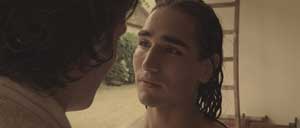
Wu’s realization of a matriarch’s last days on the planet skillfully brought together a familial ménage à trois, including perpetually feuding brother (Nicolas Berthery, all business, most of the time), sister (Noémie Merlant, radiates a complex history) and their mutual go between, Antoine (Willy Cartier, simmering with both sexes), for one last meal in the family home.
The use of flashbacks—replete with extraordinary editing thanks to the talent of Michael Lammara—gave the troubled relationships extra depth and credibility. At times a tad “on the nose,” with “Mommy always liked you best” references and the burning sexuality fuelled by Antoine, this production found itself just a nickel short of greatness. Nonetheless, the final shot spoke silent volumes which, daily, surround the inevitable comings and goings of us all. JWR
El Tiempo del Agua (Time of Water)
Shahriar Adham El Kosht
2014, 13 min.

Allergic reaction
Another troubled family provided the impetus for El Kosht’s portrait of an abandoned mother (Romina Pinto) and her precocious, promiscuous daughter (Sofia Girotto). Perpetually late house-sitter Noodle (Jonathan Yoffe)—what a delicious metaphor—whose actions most certainly had a telling effect with the payoff of a soiled sheet, provided this sad story’s glue.
Marvellously, the image of a single, verdant leaf, floating innocently atop the family’s pool, melds everything into a cohesive whole, allowing the purposely troubling finish to linger in memory far after the credits have washed away to black. JWR
Roland
Trevor Cornish
2014, 20 min.
Possible mayhem in Aisle 7
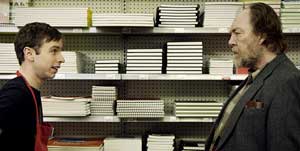
What you see is definitely not (or is it?) what you get in Cornish’s fascinating yarn about how Roland (Dan Beirne demonstrating superb acting chops), an on-the-floor customer service rep to the eclectic clientele searching through the wares of Crafty’s Art & Supply seems to find surprises wherever he turns. Not the least of which is an angry old man (Richard Denison is wonderfully manic) who is just as desperate to pee in the employees’-only loo as Roland is to bar entry (on fear of losing his job: “It’s company policy”).
As the “piss Nazi” stands his ground—with a razor-sharp box opener readily at hand—the frenzied, Psycho-like strings signal—one way or another—there’ll soon be crimson spilling onto the floor.
The aftermath seems decidedly less bloody than it might have been (or was it?), with only the curiously vanishing spots of red from Kevin’s visage diminishing the promise of “what really just happened.”
Then, the innocuous request for “paper shapers” artfully leads to a character reunion that provides a rare, narrative surprise. Nonetheless, “Clean-up in aisle 7” has seldom been actualized as such a multilayered turn of phrase. JWR
Douche (Shower)
Marie-Ève Beaumont
2013, 15 min.

Uneven, but shows promise
There’s nothing like a female-only baby shower (so I gather from well-informed sources) to bring together a covey of the fairer sex for celebration, unguarded chat, a wonderful meal—watch extra carefully for the resolution to “The Case of the Missing Lobster”—and one truth too many.
Beaumont employs a series of water images (from doctor’s-office cooler to captive, then boiled delectable seafood, through rain, then—eventually—broken) that give the production a fine unity with its title.
Yet the key slip of the tongue seems more contrived than innocent. Still, the promise of great art to come from this talented filmmaker is palpable indeed. JWR
Life’s a Bitch
François Jaros
2014, 6 min.
How to survive the pain of love lost
Those of us (er, just being all-inclusive in the universal sense of “us,” of course) who have ever been brutally dumped (“I never loved you,” beat, “Neither did I”) must find a way to see Jaros’ hilarious study of life-after-relationship death.
He’s blessed in having Guillaume Lambert portray the down-then-on-the-rebound (twice, no less) Phil.
The snappy production—with first-class editing (also by Jaros)—is a joy to behold. Not surprisingly— given the skill sets involved—the last laugh is tears-in-your-lies funny. JWR
Lifers
Joel Salaysay
2014, 10 min.

What goes on in the kitchen, stays in the kitchen
When it’s likely that the best promotion on your career path is from dishwasher to vegetable prep, it’s not difficult to understand the title of Salaysay’s portrait of the restaurant workplace.
Once Kevin (Charles Lisne, revelling in the tell-all style) reveals that he enjoys his sudsy work because “no people skills are required” and a female co-worker decisively rebuffs the amorous advances of a sous-chef (“Cock sucking also produces wrinkles,” she states in a uproariously clinical way), the knives come out—in more ways than one—sharply cutting into what life is really like for those close to the grill.
Tip: Just be sure—the next time you order your meat rare—that the blood is only from the hapless animal, not the respect-drawing, mangled hands of chef. JWR

Vanishing Points
Marites Carino
2014, 9 min.

Another feast for the eyes and ears
Similar to David Anderson’s Enemy Within, seen at the 2014 Palm Springs International Short Film Festival (cross-reference below), Carino’s dance essay is sheer gold.
The pair of dancers (Elon Höglund, Emmanuelle le Phan) artfully combine rap, ballet, street, mime and touch to bring this black-and-white gem to glorious life (André T’s score—filled with generous helpings of double bass, clarinet and all manner of percussion—is a large part of the success).
The angular, athletic choreography is at one with the streetscape set. Closer and closer the dancers come—at times merging into a singular form—until the inevitable adieu sends the camera skyward from the intersection of bodies and art, cueing the reverse-order credits, sans doute. JWR
Chocolate Milk
Michael Ring, J.R. Soldano
2013, 23 min.

Not much to laugh about
Ring’s and Soldano’s look at a pair of Odd Couple-like brothers begins with Kids in the Hall promise (the opening sequence is superb), only to quickly lose its way then descend into the unwelcome depths of done-that-been-there (and better!) tiresome.
If the magical/manic first moments could become the standard rather than the exception, then this duo should be making films forever. JWR
Le Village
Marcel Simoneau
2013, 15 min.
Everybody loses
Not far from Rimouski, Quebec (and similar to thousands of “villages” around the planet), this cautionary tale (not surprisingly based on a true story) of bullying, mischief and adultery is playing out daily, but, hopefully, not so often to such deadly effect.
After establishing the small-town credentials (a “For Sale” sign on the church speaks silent volumes), the ostracization of Pierre-Luc (aka, Fart Face) by three of his school “chums” (tellingly, the eldest and biggest of which can’t keep up with his more agile buds—calling him “slow” only reinforces the overall theme/dilemma), the plot shifts into high gear as the three amigos witness Carl (Fart Face’s dad) hooking up with Linda for a wee bit of extramarital sex down a secluded country lane.
Following the horny couple on their bikes, coitus “truckus” soon becomes the fodder for an anonymous “we will tell the whole town” letter that, once delivered, has predictably disastorous repercussions.
As guilty as Carl is, the horrific consequences—the discovery scene by Maxime Morin as his wife is brutally convincing with every anguished “no”—won’t end with his funeral.
The final moments speak incredible volumes for the sequel once it’s so briefly revealed that the distraught Fart Face clearly understands how and why his dad decided to leave the village for good.
Pathetically, revenge and settling scores of this sort will never go out of style. JWR